Sydney-wide wet-area leak detection · Inspections & reports6 days · 1300 863 001
Efflorescence is the chalky white salt left behind as water evaporates out of masonry. Rising damp is groundwater wicking up from below, usually in a tide-mark line near the floor. An active leak is water escaping from a wet area or pipe. They look similar but have different causes and fixes, so telling them apart is the first job.
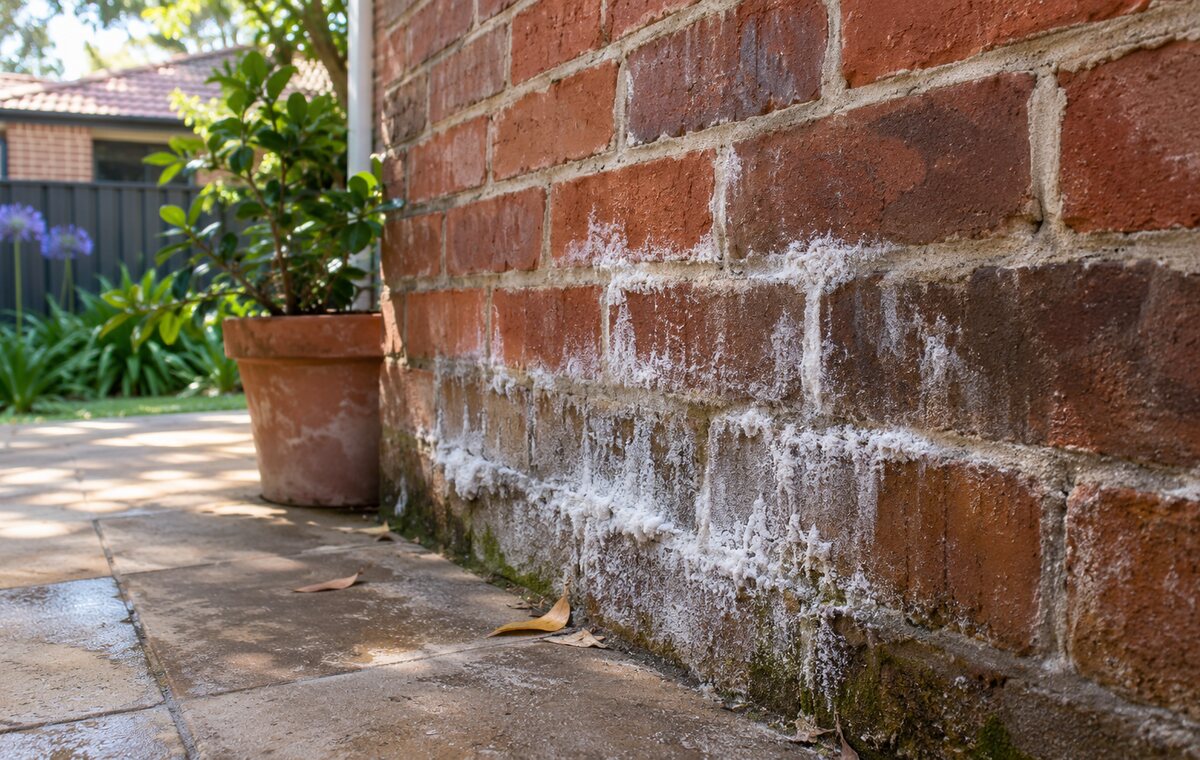
The chalky white or greyish deposit you see on brick, render or grout. It’s not the problem itself — it’s a sign that water has moved through the masonry, dissolved salts and left them behind as it evaporated. It tells you water is (or was) getting in; it doesn’t tell you from where.
Groundwater drawn up into a wall from below by capillary action. It typically shows as a horizontal ‘tide mark’ up to about a metre off the floor, often with efflorescence along it, and is worst near the base of the wall.
Water escaping from a wet area, a pipe or the building’s exterior. Unlike rising damp, it isn’t limited to the base of the wall — it can appear anywhere the water is tracking, and it often worsens with rain or water use nearby.
We tell an active leak from rising damp or efflorescence. $299 inc GST for the first hour.
Some rough indicators:
These are clues, not proof — the three often appear together, which is exactly why they get confused.
Each has a different fix: efflorescence is cleaned once the water source is dealt with; rising damp needs a damp-proofing approach; an active leak needs the source found and repaired. Treating the wrong one wastes money and leaves the real problem running. Wall leak detection uses moisture mapping and thermal imaging to tell an active leak from rising damp or simple efflorescence, so the right fix is applied.
Book an inspection and we’ll tell you what’s really behind the damp.