Sydney-wide wet-area leak detection · Inspections & reports6 days · 1300 863 001
Tiled balconies and terraces take a beating from Sydney sun and rain, and the waterproofing under the tiles is what gives out first. Here’s how to catch it before it reaches the rooms below.
Watch for a stain on the ceiling or wall in the room below the balcony, bubbling paint or crumbling render on the soffit underneath, white salt deposits (efflorescence) along the edges, drummy or lifting tiles, and water pooling instead of draining. Any of these together points to a failing membrane under the tiles.
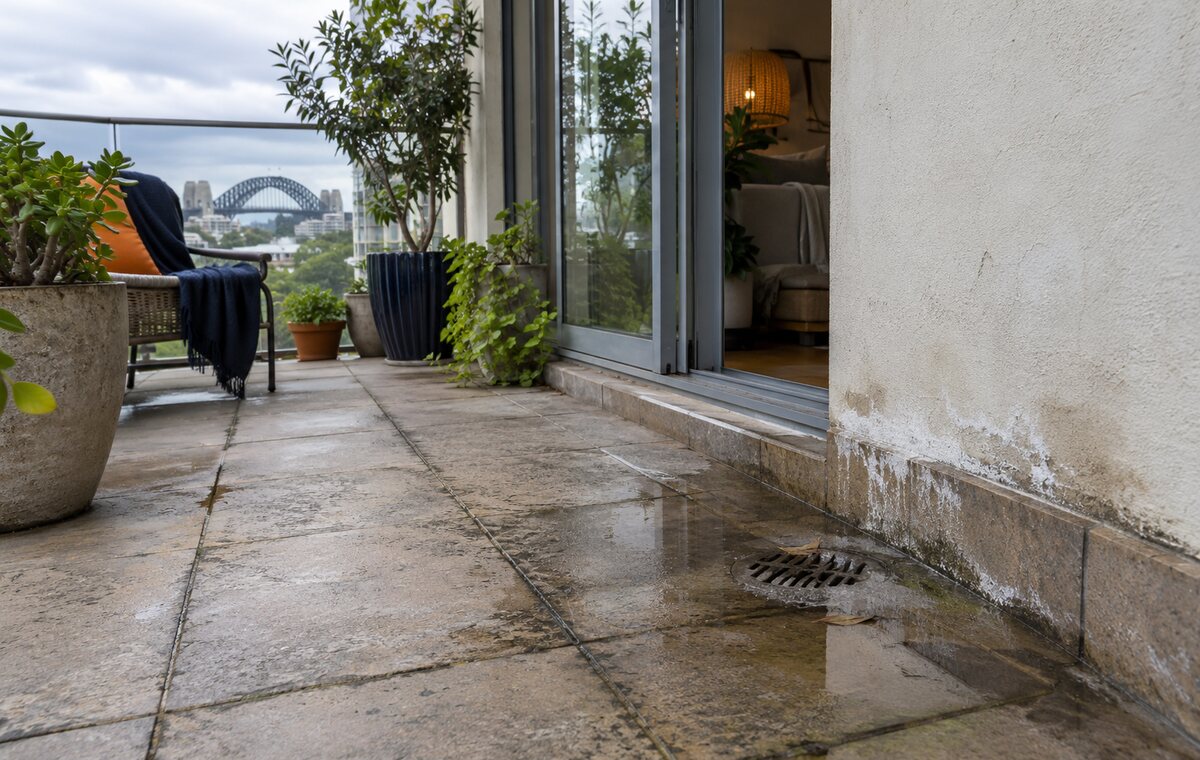
Counter-intuitively, the earliest sign of a balcony leak usually shows up inside the building, not on the balcony. As the membrane under the tiles breaks down, water tracks into the structure and appears as:
On the balcony, the tell-tale signs are:
We trace it back to where the water is really getting in. $299 inc GST for the first hour.
Balcony waterproofing fails for a few predictable reasons: age and UV breaking the membrane down, movement and thermal expansion opening joints, poor fall or blocked drainage letting water pond, and failed junctions where the balcony meets the wall or door. Once any of these lets water under the tiles, it has nowhere to go but into the structure.
Because the damage spreads to the rooms below, a suspected balcony leak is worth tracing early. Balcony leak detection locates where water is entering and how far it’s travelled — usually without lifting the tiles — so the repair targets the real failure instead of guessing. If you’re in an apartment, a clear report is often what strata or your insurer needs.
Book an inspection and we’ll find the failure before it reaches the rooms below.